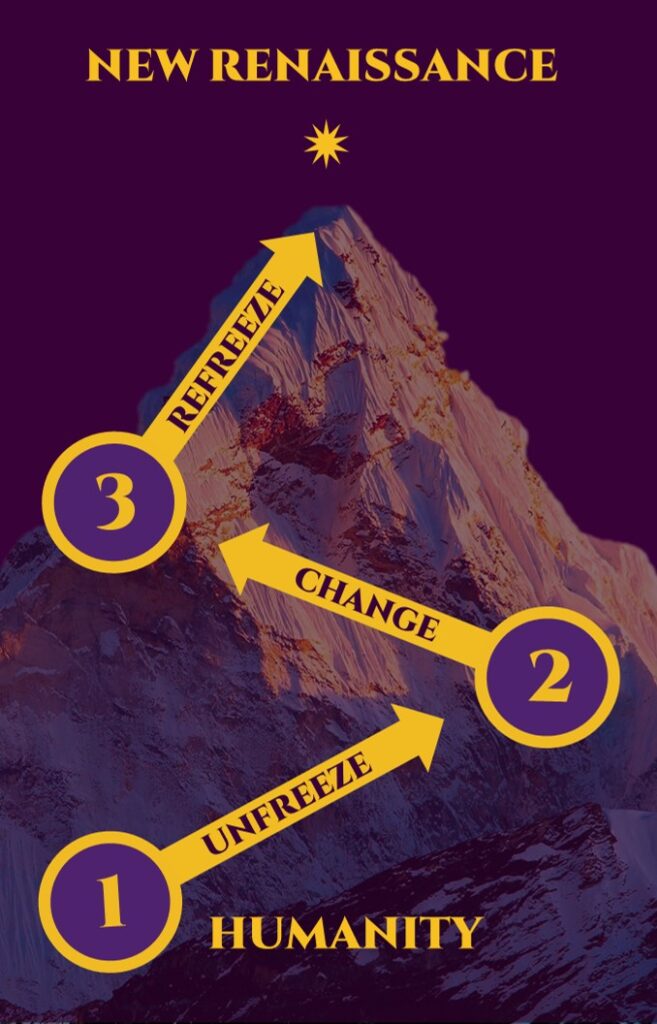
A NEW RENAISSANCE

The Renaissance roots trace to the 13th century, when Thomas Aquinas integrated Aristotle’s ideas into the Catholic Church. Before that, Plato dominated for nearly a millennium, since St Augustine of Hippo (345-430 AD). He and his followers were the leading Platonists of the medieval Church.

In 1245, Thomas Aquinas travelled to the University of Paris for a debate on Aristotle. He studied under Albert the Great, who argued that Aristotle’s worldview was compatible with Christianity. Aristotle’s idea that knowledge comes from the senses and logical inference, not innately, most influenced Aquinas.

Thomas Aquinas was the first step toward the Renaissance. He created a culture that valued reason based on logic and observation. This culture changed art and science and gave rise to masterpieces like those of Leonardo da Vinci.

Leonardo da Vinci embodied holistic knowledge and the High Renaissance. He connected science, anatomy, botany, engineering, architecture, palaeontology, cartography, painting, and sculpture. His research and inventions across disciplines, combined with his art, made him the icon of the Renaissance Man.

The Renaissance Man is the “high man,” the one who sees all knowledge simultaneously, from the top of the pyramid. Can a Leonardo exist in today’s fragmented culture? It is unlikely, but possible.

167

Today’s division of labour produces the “low man,” intelligent specialists at the pyramid’s base. They know much more, but about much less. The “high man” of ancient Athens and the Renaissance may ignore details, yet his unique view connects everything, like Leonardo, with intensity and passion.

Peikoff’s DIM Hypothesis book is useful to compare holistic and fragmented cultures. Culture must adapt to the universe, just as consciousness must adapt to existence, not the other way around.

Aquinas allowed Aristotle into the Church. Centuries later, it led to the Renaissance, then the Industrial Revolution, reaching a peak with the U.S. Declaration of Independence and Constitution. Yet, the Renaissance’s holistic culture was short-lived. The secular Renaissance man did not endure.

In the U.S., the founding fathers’ mystical Platonism diluted Aristotle’s rationality. Rational decline worsened after Kant’s Critique of Pure Reason. Two centuries later, knowledge became compartmentalized, creating a culture trapped in contradictions, cognitive dissonance, anxiety, and self-deception. People no longer lived at the pyramid’s base; they sank into cognitive holes, or worse, a cognitive hell filled with eschatological mystical nonsense.

The Middle Ages’ hell was rooted in Plato, who doubled the universe and placed consciousness above existence. The founding fathers freed themselves from the English king, but not from Plato’s primacy of consciousness over existence.

History shows humanity changes slowly, but change begins with a single person. Perhaps you. Who knows?

168

A New Renaissance must start with an individual who chooses to become an exceptional mind. It cannot arise from activists, propaganda, or government programs. Those always decay. Only self-educated parents can raise children who become champions of their own minds.

Imagine parents and children playing our game with friends. Over time, these families and societies will not need rulers to improve IQ, self-esteem, or GDP. They will become the nations of the New Renaissance in a multimodal world, something never seen before.

A holistic aristocracy of exceptional minds can achieve their finest selves while fuelling a New Renaissance, like the Medici of the 21st century. But do they exist? Where are they? What are they doing? Do they cling to colonialist thinking? Are they immune to cognitive dissonance and self-deception? Do they enjoy the wealth of real self-esteem?  Imperial capitalism is not free trade. Colonial mindset does not allow real self-esteem. Beware nuclear Armageddon.

To become champions, every ruler and subject, aristocrat and commoner, rich or poor, must know how their mind works, how their culture’s irrationality works, and especially how concepts are formed.

Just as a climber acclimatizes for Mount Everest, humanity must acclimatize the mind individually. Critical thinking and voluntary decisions allow each person to climb their rational Everest. The New Renaissance will be a society of free men who focus their minds to choose humanity’s highest possibilities.

It starts with one individual. Perhaps you. One giant leap for your mind, one small step for the New Renaissance.

Living as a rational champion is a choice. There is no destiny and no gods. You write your own story and choose how it ends. The fate of humanity depends on it.

169

Champion’s Renaissance by Charles Kocian. Copyright 2024. All rights reserved.

Translate »