Hello! I hope you are enjoying the book, although only registered members can continue.
Please register to continue the free reading. Thanks.
Please register to continue the free reading. Thanks.
To immerse you in the Mount Everest allegory, you will be the character in a simple story. It is inspired by the real story of a 40-year-old Canadian who reached the summit in May 2012.
Your story shows you why acclimatization is necessary, for your body and your mind.
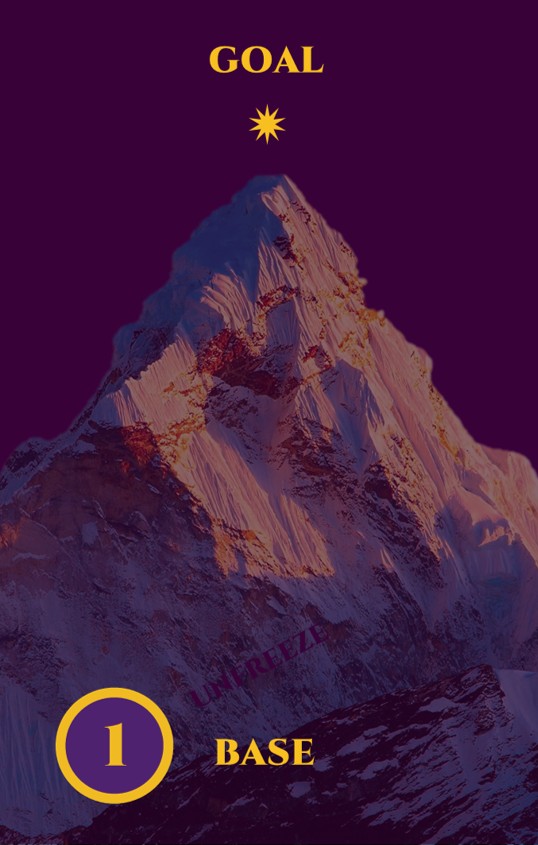
Imagine you are a climber already at Base 1, at 6,209 metres above sea level. You are ready for the final push to the summit. You reached Base 1 from Everest Base Camp. But getting there was an odyssey in itself.
Your story began 60 days earlier in Kathmandu, a large city and the capital of Nepal, at 1,400 metres above sea level. From there, you flew 40 minutes to the small airport of Lukla, a Himalayan village. It was during your journey to Base Camp that your acclimatization process began.
The chief of the expedition gave a PowerPoint presentation to explain the roadmap to Base Camp. It was a 62-kilometre trek over 11 days. A Nepalese doctor would accompany the group to monitor acclimatization and act quickly if dangerous symptoms appeared.
13
The doctor gave a presentation showing the damage low oxygen causes to internal organs.
You could feel mild symptoms such as headaches, shortness of breath, nausea, vomiting, tiredness, confusion, trouble sleeping, and dizziness. You could also feel severe symptoms from pulmonary edema (HAPE) or cerebral edema (HACE). In the first, you would feel strong shortness of breath, a dry cough, fever, and fluid in the lungs. In the second, you would experience strong and persistent confusion caused by swelling of the brain. The latter, he said, was extremely dangerous.
The general advice was to tell him immediately if any of these symptoms appeared.
He explained that mild and moderate symptoms could be reduced by drinking five litres of water per day, sleeping, and resting. Severe symptoms required descending 600 metres immediately.
After the meeting, imagine you went to downtown Lukla and spent time shopping with the locals.
Your trek to Base Camp started early the next morning. Out of 15 people, you were the only one going to the summit of Mount Everest. At Base Camp, you would join the leader of another expedition to reach the summit.
14
On the first day, you walked nine hours from Lukla to Namche Bazaar, at 3,440 metres of altitude. The path was stone, about two metres wide, with inclined planes and stairs. The sound of the Dudh Koshi River accompanied you from 100 metres below. You moved through a steep valley covered with tall green pine trees. You crossed six bridges suspended by steel cables, 100 metres above the river. Many were 300 metres long, with a path about 1.5 metres wide. The cables were deeply anchored in solid rock and concrete.
You arrived at Namche Bazaar, a small town at 3,440 metres, your first acclimatization station. A mild headache bothered you.
After two nights in Namche Bazaar, you walked seven hours to reach Tengboche, at 3,860 metres above sea level. This was your second acclimatization station. Your headache was stronger.
On the second night, Mount Everest stood under billions of stars. Above the summit, you saw a large, bright star. The image engraved itself in your mind.
Your next stop was Dingboche, at 4,350 metres of altitude. On the second night, you woke with strong nausea. You drank hot coca leaf tea, commonly used at high altitudes in Peru and Bolivia. The physical and mental disorientation you felt was part of the acclimatization process.
Your next acclimatization station was Lobuche, at 4,910 metres above sea level. The headache intensified. You drank large amounts of water and took naps.
15
A snowstorm broke out. The group stayed all day in the hotel dining room. It had a large chimney. One woman became very angry after losing a card game. She cried hysterically, insulting the other players. She vomited on the table. The doctor tried to help her. He said she needed to descend immediately. She shouted, “I am not going to trust an ignorant doctor from a third world country!” She was out of control, and her subconscious culture surfaced. Then she lost consciousness and fell to the floor.
They could not call a helicopter or descend because the storm was severe. The doctor administered a shot of dexamethasone to reduce swelling in her brain.
The next day was sunny and cold. The landscape was covered in snow. The woman appeared at breakfast. She was calm and apologized. The doctor said she had moderate cerebral edema and needed to descend urgently. She said goodbye and promised to return. She never did.
After that, you walked six hours and arrived at Gorak Shep, at 5,170 metres of altitude. You had a strong headache. On the first night, you vomited and slept poorly.
After a couple of days, you recovered. Then you climbed to Base Camp at 5,400 metres above sea level. Your headache was moderate on arrival. The group celebrated. It was the end of the journey with that group, and your last hours with them before you met the other.
16
After hugs and goodbyes, they wished you luck on the summit attempt. Then you met the leader of the summit expedition, the new team members and your Sherpa.
On the first night at Base Camp the temperature dropped to minus 15 degrees Celsius. You could not sleep because of a strong headache and nausea. You left your tent during a clear, calm night. The stars surrounded the mountains. You waited for dawn. The sun lit the summit of Mount Everest, turning it gold.
You had breakfast in the Big Black Teahouse Tent. You then spent the day training with your Sherpa on the Khumbu Glacier, drinking water to endure the headaches.
After eight days at Base Camp, your body acclimatized to 5,400 metres. The pain disappeared. You began to enjoy the landscape. At night, you heard rocks crunch as the glacier crushed them. During the day, loud avalanches fell from the steep mountains surrounding the glacier.
You had intense training. You learned to use crampons on ice, ropes and harnesses, and vertical ladders to climb large pieces of blue ice.
After 14 days of training at Base Camp, you began your first journey to Base 1. It started at midnight, with a group of 12. Your headache was mild.
17
After seven hours, you reached Base 1 at dawn. You were delighted to be there, but the mild headache persisted.
At Base 1, at 6,208 metres, you suffered insomnia and moderate nausea during the night, along with your headache. The solution? Endure the pain, drink water, and exercise patience.
The next day, the weather was great. At noon, you and half the group descended. Your headache remained. The rest of the group went up to Base 2.
When you returned to Base Camp, you rested in your tent and fully recovered by the next day.
You climbed and slept in Base 1 two more times. The second time, instead of returning, you continued to Base 2 and slept there for the first time. Headaches and nausea appeared again, then disappeared with water and rest.
After several repetitions, called “rotations,” you climbed to Base 3 for the first time, following the same criteria.
After climbing between Base 1, 2, and 3 many times, you were acclimatized. You were at Base 1, ready for your final push to the summit.
So, in your story, now you are in Base 1, with your body already acclimatized. The story will continue in Base 2.
18
Now, let’s start climbing the summit of objective philosophy and gradually acclimatize your mind.
A similar process is needed to acclimatize your mind to awaken to objective truths. Crude reality can be shocking, but it is necessary to awaken completely. You need to understand the fundamentals of metaphysics, epistemology, and ethics. It is necessary to become an optimal rational animal.
You may ask, what is the point of understanding objective philosophy? What are your benefits?
The smile you have when you reach Everest’s summit is equivalent to the smile when you reach the summit of knowledge. In both cases, you must be there to fully experience it.
What is your view from Everest’s summit? The Himalayas flow white and endless. Nepal sleeps far below, shrouded in clouds, and the Tibetan Plateau lies open and severe to the north. The sky is dark and almost empty. The earth is wide and quiet. You stand where the world thins, and all that remains is height, silence, and truth.
Everest is like a three-sided pyramid — a tetrahedron. Imagine each face a different colour. People at the feet of the yellow face see only yellow; those at the red face see only red; those at the blue face see only blue. What do they all share? Their vision is segmented. They must climb to the top to see the whole picture: objective philosophy. It allows a holistic view.
19
A compartmentalized society, derived from specialization and the division of labour, exists at the pyramid’s base. Specialists lack the holistic vision. They cannot see the big picture from the top. Reaching the top is not easy. You need patience to acclimatize your mind. Aristotle said, “The roots of education are bitter, but the fruit is sweet.” Do you agree?
You will experience pain reading this book. You must learn to manage it. It is part of your acclimatization. Expect frustration, vague anxiety, anguish, fear, evasion, confusion, disqualification, arrogance, cynicism, dispersion, blind prejudice, or depression. You may face an identity crisis, hate, rage, impotence, tiredness, sleepiness, laziness, stress, or general fatigue. Friends and family may attack you if you share your discoveries. It will not be easy. You need humility to accept your 99 percent chimpanzee DNA and courage to become an optimal rational animal.
You need to handle pain in yourself and others. Here is short advice:
If the pain is mild, resist. If it is strong, stop reading immediately. Pause your thinking on these topics. Rest for hours or days, but no more than a week. Understand that stopping is part of your acclimatization. Watch a movie, take a walk, and forget the book. When you feel ready, continue. It does not matter if you do not understand everything at first. Just continue to the end.
20
You can regularly play the game. Answering the same questions repeatedly gradually acclimatizes your mind to higher knowledge in a friendly way.
You can read the novel, perhaps more than once.
Build the habit of looking up words you do not understand while reading. Look up the words used in definitions as well.
On your first read, read the whole book quickly. Identify what you did not understand to study later. Do the same with contradictions or discordant notes. Study them later.
Read the annex with the tools of the book.
Read the books in the bibliography.
Register on the website.
Organize a group to play the game.
Make your material a metaphysical tetrahedron, as shown in the novel.
Make your material the Allegory of Albums and Folders.
The essence of acclimatization is persistence, patience, consistency, and repetition. Keep a weekly diary of your progress. Compare your current state with your starting point to see the difference.
21
Nothing more about the allegory and your acclimatization process. Now let’s quickly review the philosophical topic that follows. This first part of the book is called “Unfreeze.”
Here, you will discover contradictions between the ideas of Plato, Aristotle, and Kant. They shaped Western culture. You will learn about cultural imprinting, how sensory perceptions work, why some philosophies produce cognitive dissonance and others do not, and the difference between your neocortex and paleocortex.
Ahead are four chapters. They contain titles with a number above, corresponding to the numbered questions of the game. Text in the yellow rectangle shows the short answer that appears in the game.
Your philosophical climbing begins now. See you in Base 2.
22
Champion’s Renaissance by Charles Kocian. Copyright 2024. All rights reserved.