INTRODUCTION

Are you human only when you are rational? Yes. Can you be rational if a villain plays dirty tricks on you? No. What villain? The irrational part of your culture.

The irrational steals your real self-esteem. It does just as it stole it from Harry. Not that Harry, but a boy who represents boys and girls everywhere.

One day, when Harry was five years old, he had lunch with his parents without knowing they had argued. He saw sadness on his mother’s face and asked, “What’s wrong, Mom? You look sad.” His mother answered with a tense voice, “Nothing. Nothing’s wrong with me. I’m fine.” Then his father angrily yelled, “Don’t bother your mother!”

Harry, puzzled and unable to grasp the reproach, began to cry. His mother then sobbed and yelled at his father, “Look what you’ve done!” Harry, understanding nothing, went out to the patio to play, trying to erase the episode from his mind. What happened?

3
Seeing his mother’s sad face, Harry correctly grasped that something was bothering her. When she denied it, she invalidated what he perceived. If she had said, “Yes, I’m a little sad right now. Thanks for noticing,” she would not have denied what his eyes reported. Who tells the truth? Harry has no way to know. Should he trust his eyes or his mother’s words? It is a hard choice.

Faced with this contradiction, the child feels anxiety. Then it gets worse. His father, perhaps worried about the mother’s sadness, reprimands the child. He adds more confusion and irrationality. This is the moment when Harry wonders, If my mother is not sad, why does Dad get so angry over a simple question? Harry understands nothing. He feels hurt and helpless. His anxiety becomes unbearable and he begins to cry.

But the irrational does not end there. The mother bursts into tears and yells at the father. At the climax of the event, with anxiety overwhelming him, Harry runs to the patio to play. His mind needs to erase it urgently. He feels it as a threat to survival. In desperation, he accepts any solution, even denying what his eyes saw. What is the consequence? He learns functional self-deception to adapt.

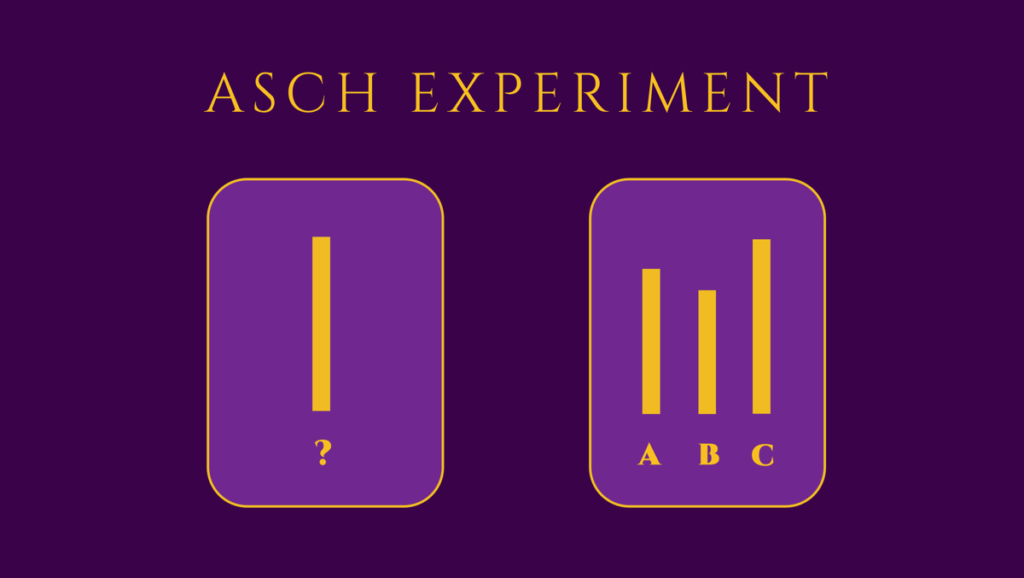
Harry’s functional self-deception is best understood through Asch’s Experiment (Fig A).

The Asch experiment, conducted by Solomon Asch in the 1950s, showed how social pressure distorts individual judgment. People often conform to a majority opinion even when it is clearly wrong. Participants were asked to match a line to one of three comparison lines.

4

The other “participants” intentionally gave wrong answers. About three quarters of real subjects conformed at least once, revealing the power of normative social influence.

Figure A

The experiment showed how a person adapts his perception to that of others. Asch asked eight students to answer incorrectly which of three vertical bars on the right card matched the sample bar on the left card. The eight students were complicit and had to lie. They were joined by a ninth participant, the subject of the experiment. He answered after the others deliberately responded wrongly. As Wikipedia says, “A considerable percentage of the subjects in the experiment responded poorly. They denied what they saw to please the group.” It is shocking to watch the experiment on YouTube. The evidence was in front of their eyes, yet they denied reality. They denied the information captured by their senses.

As in Asch’s experiment, Harry correctly perceives his mother’s sadness. When she tells him she is fine, his mind experiences cognitive dissonance. This is a contradiction between what his senses report and what authority tells him, in this case, his mother. If this repeats, Harry learns to trust authority more than his own perception, logic, reason and own experiments.

5

If man denies the perceptions of his senses, or denies that a thing is equal to itself, he corrupts his reason.

In other words, if man denies evidence and the Law of Identity, which states that each thing is itself, he abandons his human condition. If a judge denies it, he denies justice. If a scientist denies it, he denies progress.

Those afraid of being alone easily bow to the irrational. They avoid saying “no” because they fear rejection. The person who cultivates himself, who enjoys being alone with his own mind, can calmly say “I disagree” when facing irrational claims. He does not adapt to cultural irrationality. He preserves reason and self-esteem. He knows how to act under threat, as Galileo did when he told the Inquisition the Earth did not move to avoid torture. Rational, yes. Naive, no.

Psychologist Nathaniel Branden observed that children conclude, “There must be something wrong with me,” or, “I’m not up to it,” or, “When I grow up, I’ll understand.” To escape the anxiety created by a contradictory world, they invent a bad opinion of themselves. One example is Original Sin. The result is degraded reason and self-esteem.

A rational and honest person has logical integrity. He never betrays his senses and does not adapt to the irrational of his culture.

6

The strategy of self-deception used to adapt to cultural irrationality ends in depression. This disease affects about 350 million people worldwide. It destroys relationships and reduces productivity. It generates anxiety, stress, sadness, emotional instability, and suicidal thoughts, and can lead to psychosis. It causes poor decisions, weak performance at work and study, loss of focus, and memory decline. Physically, it weakens the immune system, causes headaches, fatigue, appetite loss, insomnia, reduced sexual interest, and deterioration of the hormonal and nervous systems. Self-deception also blocks access to life’s best opportunities.

The persistent problem of humanity is an imperfect mind built on low-value concepts — invalid concepts not connected to the material reality. This is the deepest root of self-deception, and the most dangerous, because it goes unnoticed.

This book gives you the tool to differentiate valid concepts from invalid ones; facts from propaganda; reality from fantasies. This tool is objective philosophy.

7

Champion’s Renaissance by Charles Kocian. Copyright 2024. All rights reserved.

Translate »