PART 2: CHAPTER 5

OBJECTIVE METAPHYSICS

25

The Reality of Nature’s Mould

In a sport-competition or war, the one who knows the terrain best, always wins.

Knowledge is power. The best informed about reality wins. To be well informed, you must think with words that point to concrete things. You need concepts anchored to the world. Ideas from evidence. Information from facts.

If a man points to a tree and says, “tree,” you know what he means. If he says, “value,” what can he point to?

If a concept refers to nothing concrete, how can you identify what it names? You cannot. You do not know the terrain. If you do not know the terrain, you cannot win. Not in war. Not in sports. Not in life. To act with certainty in the material world, you must trust only concepts that refer to something real.

60

26

Axiomatic-Concepts

Axiomatic-concepts are the fundamental premises from which objective knowledge is derived.

The axiomatic concepts are existence, identity, and consciousness. Nothing comes before them. They are implicit in all thought.

They form the base of objective reason. They are metaphysical because they refer to the entire material universe and its laws, not to anything mystical.

They are the proofs from which all objective knowledge derives. You need to grasp them with crystal clarity.

At http://aynrandlexicon.com, you can read: “An axiom is a statement that identifies the base of knowledge and of any further statement pertaining to that knowledge, a statement necessarily contained in all others, whether any particular speaker chooses to identify it or not. An axiom is a proposition that defeats its opponents by the fact that they have to accept it and use it in the process of any attempt to deny it.”

61

27

The Axiomatic-Concept of “Existence”

Existence exists, and that implies that something exists and is perceived by somebody.

“Existence” is a concept that refers to everything that exists, existed, and will exist, regardless of whether the knower is a baby or a Nobel Prize winner.

In the words of Ayn Rand: “existence exists, and the fact of learning this statement implies two corollary axioms: that something exists that one perceives, and that one exists possessing consciousness, consciousness being the faculty of perceiving what exists.”

The concept of existence identifies the difference between perceiving something and perceiving nothing. Both the material thing perceived and the subject who perceives it must exist first to say, “existence.”

The concept of existence refers to anything that exists by itself, even if nobody perceives it. Things exist independently of perception. For example, 4.5 billion years ago, the sun existed on its own, when no living beings perceived it.

It is fundamental to grasp that existence exists independently of perception. It does not cease to exist when no entities perceive it.

62

28

The Axiomatic-Concept of “Consciousness”

Consciousness begins with sensory perceptions and ends with ideas.

“Consciousness” refers to man’s psychological perceptions and actions. All psychological action begins with sensory perception. Even a newborn perceives the difference between something and nothing.

Imagine a baby without sense organs. Without perception, it cannot have consciousness. You must perceive first. From perception come ideas, actions, and emotions.

For consciousness to exist, there must be someone who perceives and something that can be perceived. Existence can exist without consciousness, but consciousness cannot exist without existence.

63

29

The Axiomatic-Concept of “Identity”

The identity concept says that things are equal to themselves.

“Identity” refers to the fact that if something exists, it is equal to itself. A thing is what it is, and not another thing. Aristotle identified this fact as the Law of Identity: “A is A.”

Every entity is equal to itself. An orange cannot be an orange and an egg at the same time. A soccer ball is a soccer ball, not a rugby ball. It cannot be inflated and deflated at the same time. It cannot be moving and static at the same time.

One thing is that thing. A fact is that fact. A is A. This is absolute, certain, and fundamental.

If a thing exists at a given moment, it exists with its own characteristics. Existence is identity. They are two aspects of the same fact.

A thing cannot exist and not exist at the same time, like an afterlife. Two truths cannot contradict each other, said Galileo. Earth cannot be moving and still at the same time.

64

30

The Axiomatic-Concepts Are Absolute

Axiomatic concepts are absolute and the basis of objective reason.

There is nothing prior to axiomatic concepts. They are the premises of all objective knowledge.

If someone denies that these axiomatic concepts are absolute, consider the following dialogue between person A and person B:

A: “No one can escape the axiomatic concepts of existence, consciousness, and identity.”

B: “I do not agree, because I am free to choose others!”

A: “You cannot choose others because you do not exist.”

B: “But I exist! I am here talking to you!”

A: “No, because you are blind and cannot talk.”

B: “I am not blind! I am looking and talking to you!”

A: “Also, you are sitting on a chair that is a table at the same time.”

B: “No! They are different things, and you know it!”

A: “Thank you for accepting the axiomatic concepts of existence, consciousness, and identity.”

B: “Did I? When?”

65

A: “When you said you existed, you accepted the concept of existence. When you said you were not blind, you accepted the concept of consciousness. When you said a table cannot be a table and a chair at the same time, you accepted the concept of identity.”

B: “Oh no!”

The axiomatic concepts are self-evident. You grasp them by observing the world. Even to deny them, you must use them. You cannot escape them. If a man denies them, he renounces reason. In that case, you cannot treat him in rational terms.

Each axiomatic concept has a corollary.

A corollary is a secondary idea derived from a primary one. It follows directly from something already proven. In logic, it is an inference that follows from the proof of another proposition.

In other words, a corollary is a fact or argument that results directly and necessarily from another one.

What follows are the corollaries of the axiomatic concepts of existence, identity, and consciousness.

66

31

First Corollary: “Causality”

Causality says that entities cause actions, and that if something is what it is, it will always act according to its nature.

“Causality” refers to the fact that entities, material things, cause their actions. There are no actions without entities acting. The entity is the cause. The action is the effect.

“Causality” is the corollary of identity. What causes an action is the entity, not another action. If an entity is equal to itself, its actions occur within the limits of its identity. A soccer ball moves like a soccer ball, not like a rugby ball. The material entity causes the action, and the action follows the entity’s identity. No entity in the universe can act against what it is. No action can exist without an entity that acts. This fact is obvious and often unnoticed, yet it is absolute. The nature of every action depends on the nature of the entity acting. For this reason, you use a ball to kick a penalty and bricks to build a house. Not bricks for penalties. Not balls for houses.

Causality explains the order of the universe. Its macro and micro entities fit like pieces of a puzzle. Their actions create a cosmic ballet. The universe’s beauty comes from causality, not from Plato’s demiurge. When you feel pleasure watching a sunset or the stars on a clear night, you grasp causality without words. It is the principle that gives the universe its beauty. When Einstein said, “God does not play dice,” he was pointing to causality.

67

32

Second Corollary: The Primacy of Existence Over Consciousness

The primacy of existence over consciousness refers to the fact that something must exists first to perceive it.

“Existence” is the cause of “consciousness”. Consciousness is its effect. The perceived entity, the material thing, and the entity that perceives it, a living being with sensory organs, must both exist first for perception to exist. Without existence, there is no consciousness. Therefore, ‘I think, therefore I am’ is false. ‘I exist, therefore I will think’ is objectively true.

If the only thing that existed in the universe were an eye with a brain floating in an empty cosmos, what light would you perceive? None. What consciousness would you have? None. For consciousness to exist, two separate entities must exist at the same time. One perceives. One is perceived. Without their existence, you cannot speak of any kind of consciousness.

The Platonic theory proposes that ideas existed first, by themselves, without brains, and then projected their shadows onto matter to create material entities, including brains. In short, Plato believed ideas could exist before a physical brain. Mystics and Platonists still believe this, but science has never proven it. Where did Plato get the idea? Born in Athens in 427 BC, his thinking reflected his cultural imprint. He grew up believing Zeus hurled lightning from the clouds. Attributing will to inorganic things is called animism, a trait of primitive cultures. Although Greek philosophers discovered great truths, they ignored electrical phenomena. Influenced by animism, Plato proposed a demiurge, or Zeus himself, as the author of the material universe.

Descartes said: “I think, therefore I am.” If you interpret this as ‘first you think, then you have a brain’, the statement is false. You cannot think without a brain. Just as you cannot have an idea without neurons, you cannot write software without micro-transistors. Existence must come first. Consciousness follows. The entity that acts, neurons or micro-transistors, must exist before the action, perception or program.
68

No consciousness can exist without a prior physical entity that acts. No idea exists without a biological brain. The zeros and ones of a program exist in micro-transistors. Ideas exist in neurons. An idea cannot exist apart from, or before, a brain, just as code cannot exist apart from, or before, micro-transistors. Whether human, machine, or divine theory, existence always precedes consciousness.

If a theory of God proposes a super-consciousness without an acting entity, its falsity is contained in the hypothesis. If God exists, it must be something else. It cannot be consciousness without existence. If God were a super-entity, like a super-brain, what created it? Another super-brain. Then another. The regress never ends. God as a super-brain explains nothing. God as consciousness without existence is false.

Therefore, Plato’s God did not create man. Primitive animism created gods. Rulers then used them to rule and send others to war. Science shows that life emerged without divine assistance. Natural entities and their actions produced life, acting randomly but according to their identities, as established in the Periodic Table of the Elements.

69

33

Third Corollary: Natural Things Are Given and Absolute

The material universe is given, natural and has absolute laws.

Natural things are given and absolute. They are neither good nor bad. They simply are, and they exist by themselves.

Nature is the set of entities that exist in the universe. They follow absolute laws. They act by them. They relate by them. They existed long before humans noticed and will continue when humans vanish.

All natural entities obey absolute laws, starting with identity, causality, and other axiomatic concepts with their corollaries.

Every successful culture adapts to nature, just as you can choose to be the champion of yourself.

A coin cannot be pure gold and pure copper at the same time. It cannot be solid and melted at the same time. A is A.

70

34

The Concept “Entity

The concept “entity” is also axiomatic, but not primary.

The concept “entity” is grasped by a baby without words, once consciousness emerges from the flood of sensory stimuli in the first weeks of life. After several months, the brain integrates scattered sensations and captures things, objects. This is when the baby grasps, without words, the concept of “entity”.

To reach this, the brain must first differentiate one thing from another. Cognition does not arise automatically from simply looking at the world.

Before speech, the child realizes objects exist and can be distinguished. The bed is soft. The table is hard. He learns without words that things behave consistently. He may try to drink milk from a pacifier, then realizes no milk comes. He understands the difference between pacifier and bottle. By identifying differences, he sees that objects behave predictably. If he could speak, he would say: “These objects are entities. Each is different and behaves differently. I know they exist because I can touch them and point.” This is when he grasps the concept “entity”.

Objective-entities differ from imaginary-entities. Objective-entities are physical objects all humans can perceive. Imaginary-entities exist only in one person’s imagination. Objective entities arise from shared observation. Imaginary entities come from isolated fantasy.

An entity is an aspect of “existence”. Real things exist as entities, with identity. Real entities are things, objects, nouns. Thinking and speech operate with entities, since adjectives and verbs gain meaning only through relation to an entity. The entity is the noun and subject of a grammatical proposition.

Entities differ and act according to causality, following their identities. Movement without a moving entity is impossible. The color red without a red entity is impossible. Actions and characteristics require entities, which always behave according to their identities.

71

35

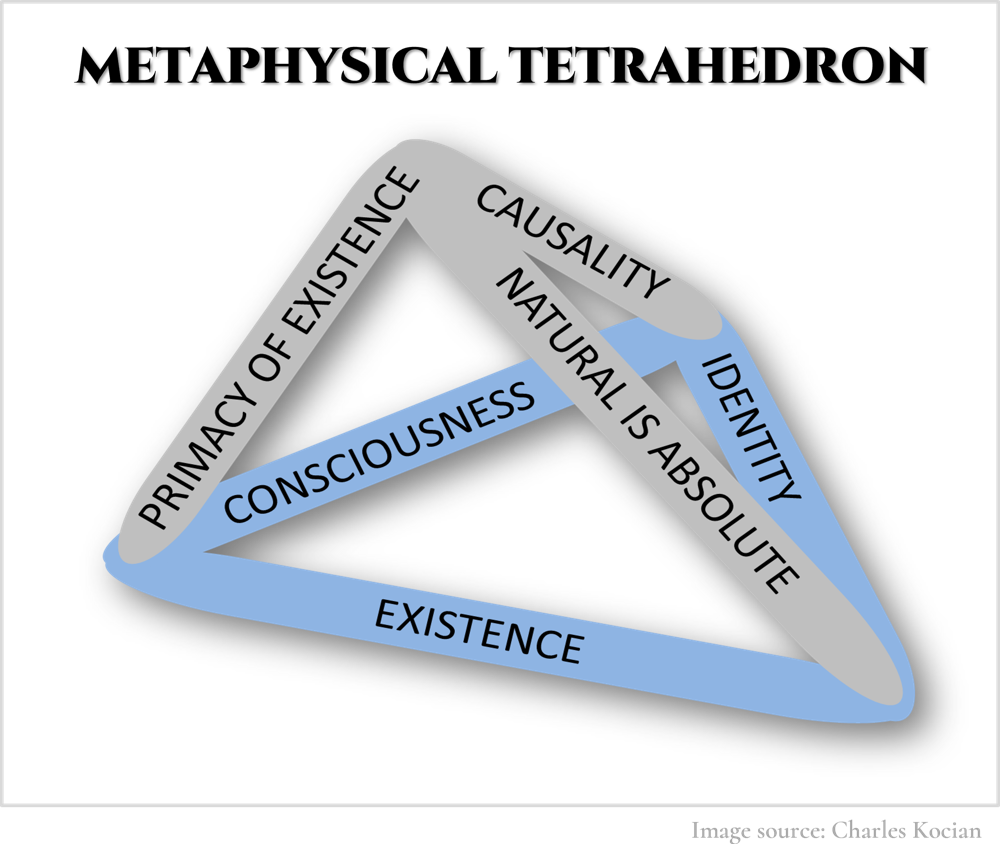
The Allegory of the Metaphysical Tetrahedron

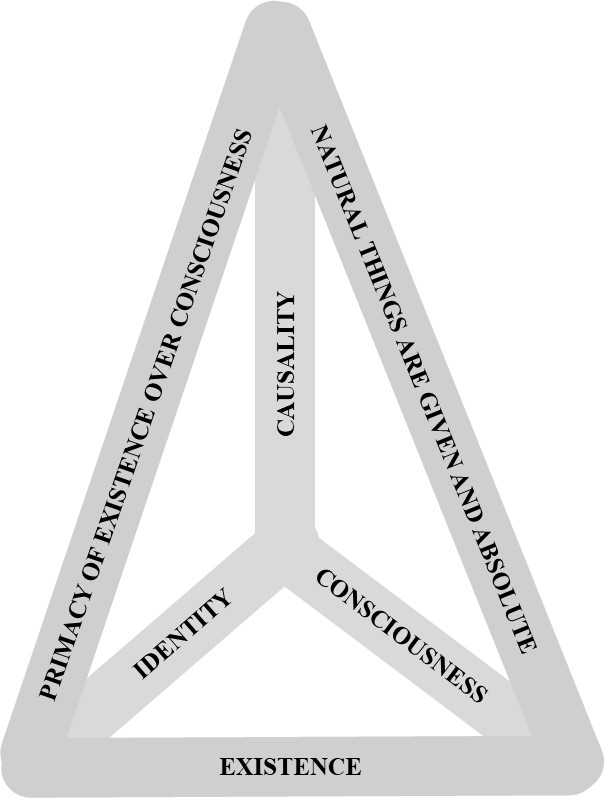
The Allegory of the Metaphysical Tetrahedron illustrates how the axiom-concepts and their corollaries are connected.

The Allegory of the Metaphysical Tetrahedron is a model of six edges connected at their ends. Each edge carries an inscription: the three axiomatic concepts — existence, consciousness, identity — and their three corollaries — causality, primacy of existence over consciousness, and natural things are given and absolute.

The tetrahedron’s undeformable geometry is a metaphor for absolute axioms and their corollaries. Drawing or building the sculpture deepens understanding and strengthens memory. The author recommends making the tetrahedron, as it is a powerful mental tool for change. Simply seeing it helps retain the axioms, and the sculpture settles in the mind as a milestone, around which a new objective mental order forms.

You can place your sculpture at home or in the office, or use it as a Christmas tree, just like the heroes of the novel ONE EXCEPTIONAL MIND, who, by the way, as you may know, are the characters who wrote this book.

72

Champion’s Renaissance by Charles Kocian. Copyright 2024. All rights reserved.

Translate »