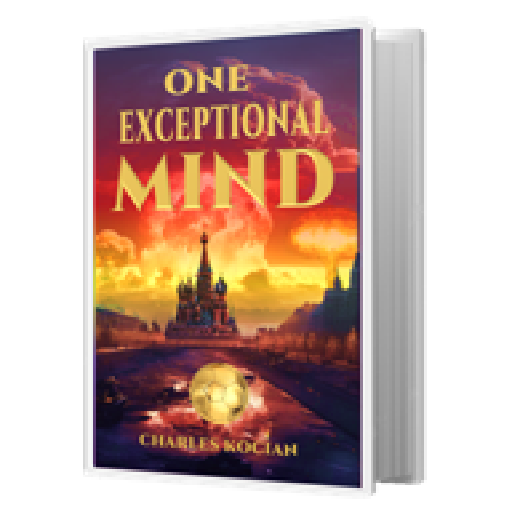
Hello! I hope you are enjoying the book, although the best is yet to come. Buy it for $10 dollars. Thank you!

Buy the book

ACT II - CHAPTER 11

NUCLEAR SHELTER IN NORWAY

Sunday August 5, 2018

In a cabin at the foot of a lake in Norway

Three hundred kilometers north of Oslo

A week after the meeting at Villa Ascolassi in Norway, three hundred kilometers north of Oslo, the day ended at 9:30 p.m. The cabin sat on a quiet lake peninsula between high, rugged mountains, far from civilization.

A wooden cabin next to a helipad, surrounded by gardens, smelled of flowers on the soft breeze. Sunlight cast long shadows. At the tip of a narrow peninsula, its high gabled roofs formed large eaves that covered part of a wooden terrace along the lake, leading to a dock and a sailboat.

The main entrance opened through a porch under the eaves to a square hall. One side led to the living room, dining room, and kitchen. The other led to the sleeping area: a suite, two rooms, closets, and bathrooms.

The sleeping area had horizontal ceilings of normal height. The living, dining, bar, and kitchen space shared a single high ceiling, inclined and supported by thick wooden beams that extended outside, forming wide eaves over the terrace. Two-meter-high walls defined the hall and kitchen but did not reach the ceiling. The taller wall separating the living space from bedrooms extended to the roof. The open kitchen overlooked the dining room with a round table for ten, the bar, and the living room. Large windows, sliding doors, and skylights filled the space with light and integrated it with the lake views.

306

Thermal curtains and movable lattices, controlled by artificial intelligence, adjusted sunlight and temperature. Floors, walls, and ceilings were wood.

Below the cabin, an underground concrete bunker mirrored the cabin’s dimensions. A wide, hidden sliding door in the hallway of the sleeping area disguised as a bookcase gave access. Pressing four book spines in sequence for ten seconds unlocked it, revealing a staircase with wooden steps down to a distribution hall.

The main bunker room matched the upstairs living space. It had a lounge, bar, and pool table. One corner held a computer station with multiple screens. Floor-to-ceiling bookcases surrounded the room with thousands of volumes: art, geopolitics, philosophy, computing. Floors and ceilings were wood.

From the distribution hall, a hallway led to various rooms, including one with internet servers. A secret door took ten seconds to open and led to a distribution hall with a freight elevator, staircase, and ventilation ducts. These went down twenty floors to the nuclear shelter, sixty meters below the surface. It had all supplies to keep twenty people alive for five years. Power came from a small modular nuclear reactor.

Ronald practiced security drills regularly. He timed the escape to the nuclear shelter: 282 seconds if in the house. Two and a half minutes to reach the elevator gates, forty-two seconds to activate the shelter, one minute to descend. Thirty seconds were needed to open and close the vault-style door. He knew a nuclear blast above could trap them if the door remained open. Missiles would likely come from Russia, Europe, or the US. Detection radars reached 200 kilometers, giving thirteen minutes for subsonic missiles, less than a minute for hypersonic. A satellite and early-warning showed launches on a phone, triggering alarms.

Mr. Walker had spent a fortune building the complex, completed a decade ago, designed with his daughter fifteen years prior. Maintenance ran automatically with AI and robots. From outside, it looked like a lakefront cabin with a dock and sailboat.

The living room opened onto a wooden terrace. Under the eaves, an outdoor space had a leather sofa and two ivory armchairs around a marble table. On it lay a light green pendrive and a binder labelled ‘DRAFT.’ Nearby, a half-full whiskey bottle and two Czech crystal glasses.

307

A marble bust of Aristotle stood on a side table; another bust of Hypatia of Alexandria sat across, at eye level with seated guests. The terrace, as wide as a dance floor, rested on beams over the lake. Orange sunlight reflected on the calm waters stretching to distant mountains.

A distant helicopter broke the silence. A Norwegian Golden Eagle perched on the terrace railing. Seeing the helicopter, it took off, flapping wings toward two black dots descending at high speed from the sky. The eagle appeared smaller; the dots grew larger.

The first parachute opened like Norway’s flag, the second like the United Kingdom’s. The rush of fabric broke the valley’s silence, which returned seconds later.

She guided her parachute, admiring the cabin terrace below. A Norwegian Golden Eagle escorted her. Dad, you always accompany me, she thought smiling. She adjusted her descent speed using the parachute controls. Noticing the lack of wind, she decided to gain speed and brake sharply before landing.

Another parachute descended, spinning at full speed, passing very close to her. “My love! You’re an exquisite daredevil, but I don’t like you taking these risks,” she murmured.  Seconds later, she saw him land, gather his parachute, and step aside to give her space.

With her hands at head height, she guided her parachute at full speed toward the landing point. At the right moment, she lowered her hands to hip height and braked. Her bare feet touched the wooden planks softly.

She gathered the parachute, smiled at the man she loved, and shook her head, showing admiration but reproaching his risky manoeuvre.

At first, she feared falling in love. In the end, she realized they shared the same values. She surrendered to his charm, humour, and intelligence.

She had helped him be reborn.

He had helped her be reborn.

About ten paces away, he sat on the sofa under the eaves. A strong young man with an alert gaze and mischievous smile, he held a glass of whisky in his left hand and the pendrive of the book in his right.

She looked at him from her calypso eyes, removed her leather helmet, and let her long, curly red hair fall. He admired her with reverence. The lake water matched her eyes. A light-green diamond tetrahedron hung from a gold chain on her chest.

308

From the terrace railing where the Norwegian Golden Eagle had perched, she blew him a kiss, turned on her heel, and threw a stone into the lake. They heard it sink, sending waves outward.

He rose from the couch, pendrive in hand, and walked to watch the waves.

“That is how objective truth will travel the world,” he said, pointing at the waves with his right index finger. “And this is the stone,” he added, raising the pendrive in his other hand.

They watched in silence as the waves advanced. He returned to the couch. The statuesque redhead followed and crouched in front of him, resting her forearms on his thighs. She looked at Aristotle’s bust and kissed his lips, as if trying to resurrect the philosopher from the marble.

“Do you think he will resurrect?” she asked.

“Who wouldn’t with that kiss,” he said.

“Will you resurrect?” she asked.

“Only for my friends,” he replied.

“Will the others be reborn?” she asked again.

“They are free to choose. Here is their freedom,” he said, holding up the pendrive.

Hand in hand, they walked to where she had thrown the stone, watching the waves and the first star shining.

She felt joy over the previous week’s meeting at Villa Ascolassi, though convincing Arturo to take a year to polish the book had been difficult. She had followed his notes precisely, and everything went smoothly. The surprise date was set for one year, allowing him to strengthen valley surveillance. He planned to make the cabin invisible, including launching a private satellite so no one could detect them.

Waiting in the anti-nuclear shelter for Armageddon had been hard, but necessary to dismantle The Family and continue producing the book.

Like Arturo, Ricardo, Alexandre, Victoria, and his beloved Francisca, Ronald Williams was alive. He knew where he was, how he knew it, what to do, and how to finish and publish the book so it would last for centuries.


END ACT II

309

One Exceptional Mind, by Charles Kocian. Copyright 2025. All rights reserved.

Translate »